✔ EN 1 Lorem ipsum dolor sit ✔ EN 2 Lorem ipsum dolor sit
Become a member and secure exclusive benefits
✔ EN 4 Lorem ipsum dolor sit ✔ EN 5 Lorem ipsum dolor sit
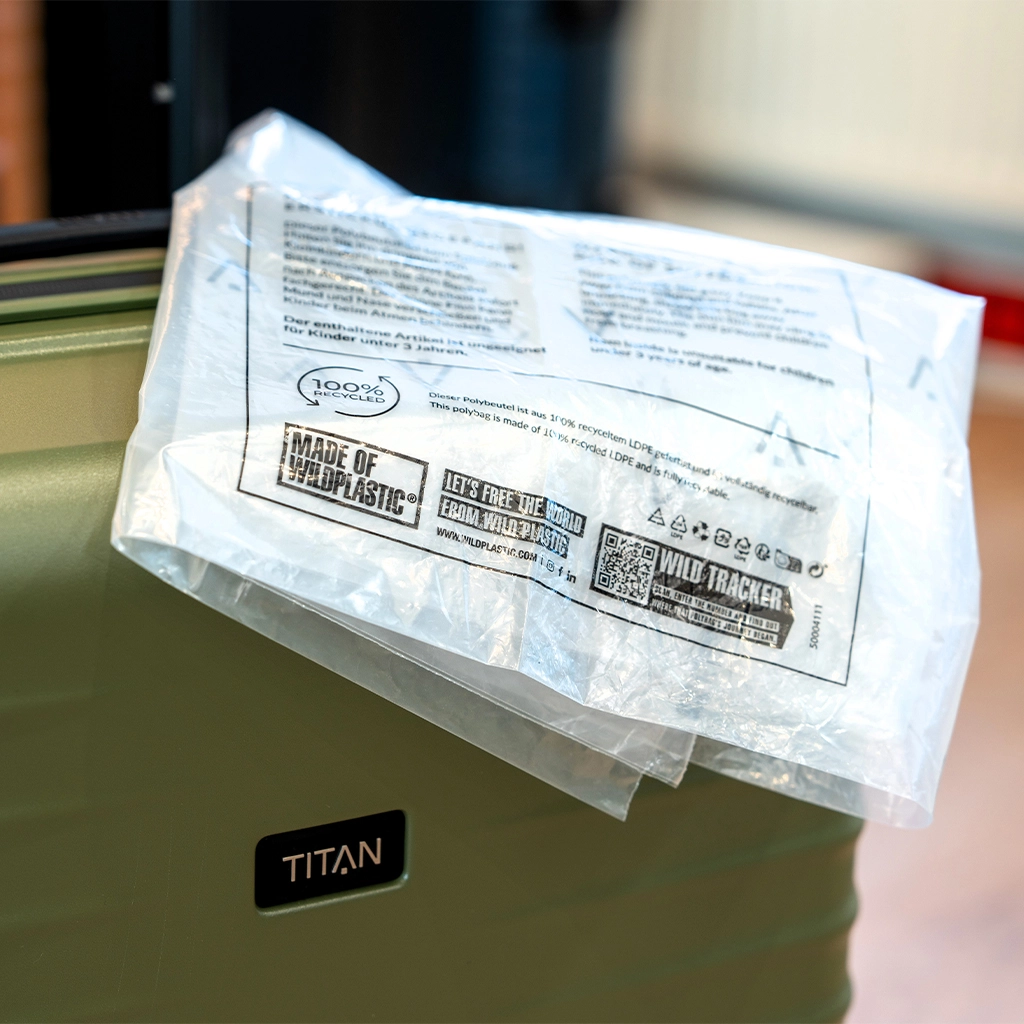
Close-up of an olive green titanium suitcase with a horizontal groove structure. On top of the case is a transparent plastic bag with imprints on the subject of wild plastic and recycling. The TITAN logo is visible in the centre of the case.
A slightly blurred shot of a transparent plastic bag lying on an olive green suitcase. The bag is labelled "Made of wildplastic" and features other logos and a text about recycling.

Focus on sustainability: A conversation with our partner WILDPLASTIC® 

Sustainability is no longer a trend, but a commitment. At TITAN, we focus on the highest quality and durability of our products. But for us, sustainability goes beyond production: it starts with the packaging. That is why we are delighted to introduce our partner WILDPLASTIC® today - a company that is committed to saving wild plastic and is active worldwide with unique recycling approaches.

Find out more about the foundation, mission and sustainable processes behind WILDPLASTIC® in the interview.

Because quality and sustainability also go hand in hand when it comes to packaging.


How did the idea behind WILDPLASTIC® come about? 

The idea came from one of the most pressing problems of our time: there are over 5 billion tonnes of plastic in the environment - an enormous burden on people, nature and the climate. We didn't just want to talk about it, we wanted to actively change something. That's why, in 2019, seven people with very different backgrounds - from design, entrepreneurship, sustainability and activism - came together to take wild plastic out of the environment and make it visible through innovative products. This became WILDPLASTIC®. Our aim is to establish this material as a valuable raw material and thus close the cycle. Today, we work with organisations around the world, saving plastic before it causes lasting damage and further establishing wild plastic as a recyclable material. 

What exactly is "wild plastic"? 

The term "wild plastic" describes all plastic that currently exists outside the closed recycling loop. This is, for example, plastic that is found in the environment, in illegal landfill sites, on the streets or simply in nature.

Focus on sustainability: A conversation with our partner WILDPLASTIC® 

Sustainability is no longer a trend, but a commitment. At TITAN, we focus on the highest quality and durability of our products. But for us, sustainability goes beyond production: it starts with the packaging. That is why we are delighted to introduce our partner WILDPLASTIC® today - a company that is committed to saving wild plastic and is active worldwide with unique recycling approaches.

Find out more about the foundation, mission and sustainable processes behind WILDPLASTIC® in the interview.

Because quality and sustainability also go hand in hand when it comes to packaging.

How did the idea behind WILDPLASTIC® come about? 

The idea came from one of the most pressing problems of our time: there are over 5 billion tonnes of plastic in the environment - an enormous burden on people, nature and the climate. We didn't just want to talk about it, we wanted to actively change something. That's why, in 2019, seven people with very different backgrounds - from design, entrepreneurship, sustainability and activism - came together to take wild plastic out of the environment and make it visible through innovative products. This became WILDPLASTIC®. Our aim is to establish this material as a valuable raw material and thus close the cycle. Today, we work with organisations around the world, saving plastic before it causes lasting damage and further establishing wild plastic as a recyclable material. 

What exactly is "wild plastic"? 

The term "wild plastic" describes all plastic that currently exists outside the closed recycling loop. This is, for example, plastic that is found in the environment, in illegal landfill sites, on the streets or simply in nature.

One hand holds an olive green "Titan" trolley travelling bag. The bag is wrapped in a transparent plastic film with warning labels and is in a brown cardboard box. There is other luggage in the background.

How do you collect the plastic? Are there volunteers or do you use special tools?

We work with partner organisations around the world, in countries such as India. These organisations coordinate the collection of wild plastic on site together with local collectors. We attach great importance to transparency and fair cooperation: we buy the material directly from our partners and thus support local structures. To ensure that certain standards are adhered to, all partners undertake to comply with our WILDPLASTIC® Cooperation Requirements, a clearly defined set of rules that includes ecological, social and ethical principles. We are also in continuous dialogue, visit the organisations regularly and develop the processes together to ensure sustainable and trusting partnerships.

One hand holds an olive green "Titan" trolley travelling bag. The bag is wrapped in a transparent plastic film with warning labels and is in a brown cardboard box. There is other luggage in the background.

How do you collect the plastic? Are there volunteers or do you use special tools?

We work with partner organisations around the world, in countries such as India. These organisations coordinate the collection of wild plastic on site together with local collectors. We attach great importance to transparency and fair cooperation: we buy the material directly from our partners and thus support local structures. To ensure that certain standards are adhered to, all partners undertake to comply with our WILDPLASTIC® Cooperation Requirements, a clearly defined set of rules that includes ecological, social and ethical principles. We are also in continuous dialogue, visit the organisations regularly and develop the processes together to ensure sustainable and trusting partnerships.

And what happens after the collection? Is all the plastic found in the environment processed or are there requirements for the plastic you can use?

A crucial step in our process is the cleaning of the collected material. Contamination, chemical residues or plastics that cannot be separated can significantly affect the quality and safety of the end product. That's why we have clear requirements: The material must be sortable and recyclable. Heavy chemical contamination or impurities rule out recycling. In addition, the quality must be so high that a safe and functional end product can be created from it. Our aim is to salvage as much suitable material as possible and at the same time ensure that it is used to make durable, high-quality products. That's why we work closely with our partner organisations and recycling companies to always achieve the best possible result.

You collect wild plastic from India, Indonesia and Senegal. Isn't that an enormous logistical effort? Why did you decide to start in these countries and not in Europe?

Of course, logistics is a major challenge in this context. In countries like India, for example, there are often no functioning waste or recycling systems as we know them in Europe. There is a lack of comprehensive waste collection, organised collection points and clear structures - which is why a lot of plastic ends up uncontrolled in the environment there. In contrast, Europe has largely functioning cycles: waste is collected, sorted and at least partially recycled. As a result, the quantities of wild plastic in nature here are comparatively low. Our mission is to start exactly where the problem is particularly visible and urgent. This means working with local partners to establish structures on the ground, remove the material from the environment and reintroduce it into the resource cycle. In this way, we create not only an ecological but also a social impact.

And what happens after the collection? Is all the plastic found in the environment processed or are there requirements for the plastic you can use?

A crucial step in our process is the cleaning of the collected material. Contamination, chemical residues or plastics that cannot be separated can significantly affect the quality and safety of the end product. That's why we have clear requirements: The material must be sortable and recyclable. Heavy chemical contamination or impurities rule out recycling. In addition, the quality must be so high that a safe and functional end product can be created from it. Our aim is to salvage as much suitable material as possible and at the same time ensure that it is used to make durable, high-quality products. That's why we work closely with our partner organisations and recycling companies to always achieve the best possible result.

You collect wild plastic from India, Indonesia and Senegal. Isn't that an enormous logistical effort? Why did you decide to start in these countries and not in Europe?

Of course, logistics is a major challenge in this context. In countries like India, for example, there are often no functioning waste or recycling systems as we know them in Europe. There is a lack of comprehensive waste collection, organised collection points and clear structures - which is why a lot of plastic ends up uncontrolled in the environment there. In contrast, Europe has largely functioning cycles: waste is collected, sorted and at least partially recycled. As a result, the quantities of wild plastic in nature here are comparatively low. Our mission is to start exactly where the problem is particularly visible and urgent. This means working with local partners to establish structures on the ground, remove the material from the environment and reintroduce it into the resource cycle. In this way, we create not only an ecological but also a social impact.

The tracking code, which tells you where the plastic in the product comes from, how much CO2 has been saved and how much plastic has been collected, is a great idea. How do you implement this technically? 

 The tracking code is based on the individual data of each cooperation, i.e. where the plastic comes from and how much was collected and processed. This information, together with our life cycle analysis (LCA), is used to calculate the CO₂ savings and also takes into account the impact of our work in the respective project. In this way, we make transparent what difference each individual product actually makes.

What can each and every one of us do to reduce plastic consumption? 

Everyone can do something to reduce plastic consumption: avoid plastic wherever possible, shop more consciously and opt for sustainable alternatives. If it is not possible to avoid plastic altogether, it is particularly important to separate waste properly – for example, remove the lid from the yoghurt pot – and never leave waste lying around in the environment. 

A transparent plastic bag with texts and logos lies on an olive green suitcase. The logos "Made of Wildplastic" and "Wild Tracker" can be seen on the bag. The case has a black label with the words "TITAN".

The tracking code, which tells you where the plastic in the product comes from, how much CO2 has been saved and how much plastic has been collected, is a great idea. How do you implement this technically? 

 The tracking code is based on the individual data of each cooperation, i.e. where the plastic comes from and how much was collected and processed. This information, together with our life cycle analysis (LCA), is used to calculate the CO₂ savings and also takes into account the impact of our work in the respective project. In this way, we make transparent what difference each individual product actually makes.

What can each and every one of us do to reduce plastic consumption? 

Everyone can do something to reduce plastic consumption: avoid plastic wherever possible, shop more consciously and opt for sustainable alternatives. If it is not possible to avoid plastic altogether, it is particularly important to separate waste properly – for example, remove the lid from the yoghurt pot – and never leave waste lying around in the environment. 

We would like to thank our partner WILDPLASTIC® for the exciting exchange and look forward to working together to help transform plastic from the environment into stylish packaging. Would you like to find out more about sustainability at TITAN? Then take a look here .